-

-
How to master your Fes to Marrakech desert tours for a perfect trip
- blitzmaz 5 Months+ 41
The transition from the scholarly, medieval heart of Fes to the vibrant, high energy atmosphere of Marrakech is a journey that every traveler should undertake at least once in their lifetime. This specific route is not merely a transfer between two cities; it is an expedition through the very soul of Morocco. By choosing professional Fes to Marrakech desert tours, you are opting for a narrative that includes the snow capped peaks of the High Atlas, the verdant palms of the Ziz Valley, and the legendary golden dunes of the Sahara. This path follows the ancient caravan routes that once brought spices, gold, and salt across the continent, offering a profound connection to the historical heartbeat of North Africa. As we look toward travel trends in 2026, the demand for immersive and slow travel has never been higher. According to recent insights from Google News, Morocco welcomed 4.3 million tourists in the first quarter of 2026 alone, marking a 7% increase as the "Light in Action" roadmap continues to draw global interest. This article serves as your comprehensive guide to navigating this spectacular landscape, ensuring that your journey across the Moroccan wilderness is as informative as it is breathtaking.
Decoding the geography and logistics of the trans Saharan route
Understanding the physical terrain is the first step in mastering Fes to Marrakech desert tours. The journey covers approximately 550 to 650 kilometers, depending on the specific detours taken. This is not a drive to be rushed in a single day; instead, it is best experienced over three or four days to allow for proper acclimatization and exploration. The route begins with the dramatic ascent of the Middle Atlas Mountains. For a technical understanding of the desert formations you will encounter later, Wikipedia defines the Sahara as a diverse region composed of rocky plateaus known as hamada and sand seas called ergs. An erg is specifically a broad, flat area of desert covered with wind swept sand with little or no vegetative cover. This contrasts with the hammada, which characterizes much of the terrain before you reach the dunes. Crossing the Ifrane National Park is the first major milestone, where the architecture shifts to a Swiss style aesthetic, a fascinating contrast to the traditional riads of Fes.
The engineering of the roads through the Atlas Mountains is a marvel, winding through switchbacks that reveal hidden Berber villages made of stone and earth. These communities have lived in harmony with the rugged terrain for centuries, maintaining traditional agricultural practices that are still visible from the roadside. After descending toward Midelt, the landscape transforms into the Ziz Valley. This region is characterized by immense canyons filled with date palms, appearing as a lush green ribbon that cuts through the scorched limestone cliffs. Exploring these oases provides a window into the traditional irrigation techniques of the south, where water management is both a science and an art form passed down through generations.
The immersive desert experience at Erg Chebbi and Merzouga
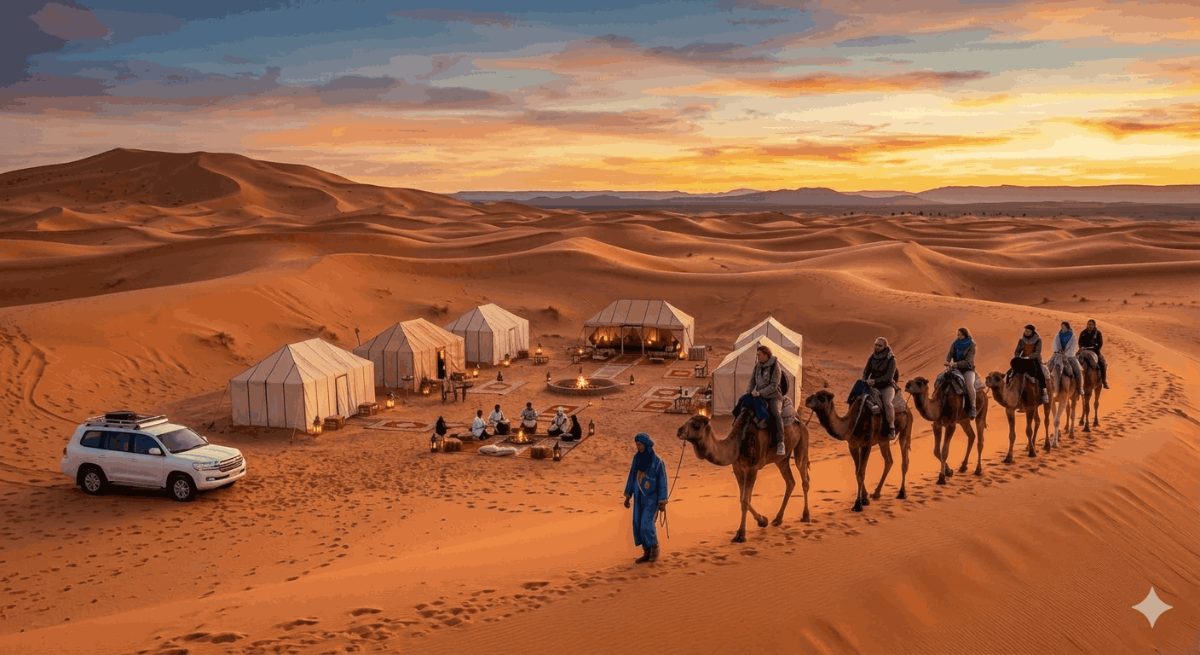
The focal point of all Fes to Marrakech desert tours is undoubtedly the Merzouga region, home to the stunning dunes of Erg Chebbi. Unlike the flat, rocky desert found in other parts of the country, Erg Chebbi is a massive field of wind blown sand that reaches heights of up to 180 meters. Arriving here feels like stepping onto another planet. The sand is remarkably fine and changes color throughout the day, shifting from a pale lemon yellow in the morning to a deep, fiery orange at sunset. The traditional way to enter the dunes is via camel trek. These resilient animals, often called the ships of the desert, are perfectly adapted to the environment. Their rhythmic gait allows you to settle into the pace of the Sahara, leaving the noise of modern life far behind.
In 2026, the standard for desert accommodation has reached new heights of sophistication. As reported by Forbes, Morocco has solidified its status as a global high end destination, with Marrakech leading the way in luxury hospitality that often extends into personalized desert escapes. This excellence is visible in luxury desert camps that offer five star amenities in the middle of the wilderness. These camps feature spacious tents with comfortable beds, private bathrooms, and gourmet dining experiences. Spending a night under the Saharan sky is a transformative experience. Without the interference of light pollution, the Milky Way appears with startling clarity, stretching across the horizon in a dense band of starlight. Many tours include traditional Gnawa music around a campfire, where the hypnotic rhythms of the drums and metal castanets tell stories of the desert’s spiritual heritage.
Traveling from the golden dunes to the red city of Marrakech
Leaving the Sahara behind is often bittersweet, but the final leg of the journey toward Marrakech offers a brand new set of wonders. The transition begins along the "Road of a Thousand Kasbahs," a historic route dotted with ancient earthen fortresses. You will pass through the Todra Gorge, a massive limestone canyon where the walls rise nearly 300 meters above the riverbed. Walking through the narrowest part of the gorge allows you to appreciate the raw power of nature. As the road continues west, you begin to climb once again, this time into the High Atlas Mountains. This range is the highest in North Africa, and crossing the Tizi n'Tichka pass at 2,260 meters provides panoramic views that are truly world class.
This area is also home to the UNESCO World Heritage site of Ait Ben Haddou. This fortified village is a striking example of southern Moroccan clay architecture and has served as the backdrop for countless cinematic masterpieces. Seeing these ancient structures in their natural habitat is a highlight for history lovers and photographers alike. The air here is crisp and scented with wild herbs, providing a refreshing change after the heat of the desert. The final descent brings you toward the plains of Haouz, where the red walls of Marrakech finally appear. By the time you arrive at your destination, you will have a comprehensive understanding of the country’s geography, history, and cultural nuances.
Conclusion
Completing one of the many Fes to Marrakech desert tours is more than just a checkmark on a travel bucket list; it is an education in the resilience of nature and the richness of human culture. You will have crossed two mountain ranges, slept in the world’s largest hot desert, and witnessed the architectural evolution of a kingdom. This route provides a perfect balance of adventure and comfort, making it accessible to anyone with a spirit of curiosity. To ensure the best possible experience, it is recommended to book with a reputable tour operator who prioritizes sustainable practices and local guides. By doing so, you contribute to the preservation of these delicate environments and support the communities that make Morocco so unique. Are you ready to witness the sunrise over the Erg Chebbi dunes and walk the ancient paths of the Atlas? Now is the time to start planning your 2026 Moroccan expedition. Contact a travel specialist today to customize your itinerary and prepare for a journey that will stay with you forever. The road from the spiritual capital to the Red City is open, and the desert is calling.
travel
|
|
|---|---|
|
|
|
- Time: 0.116, SQL: 13